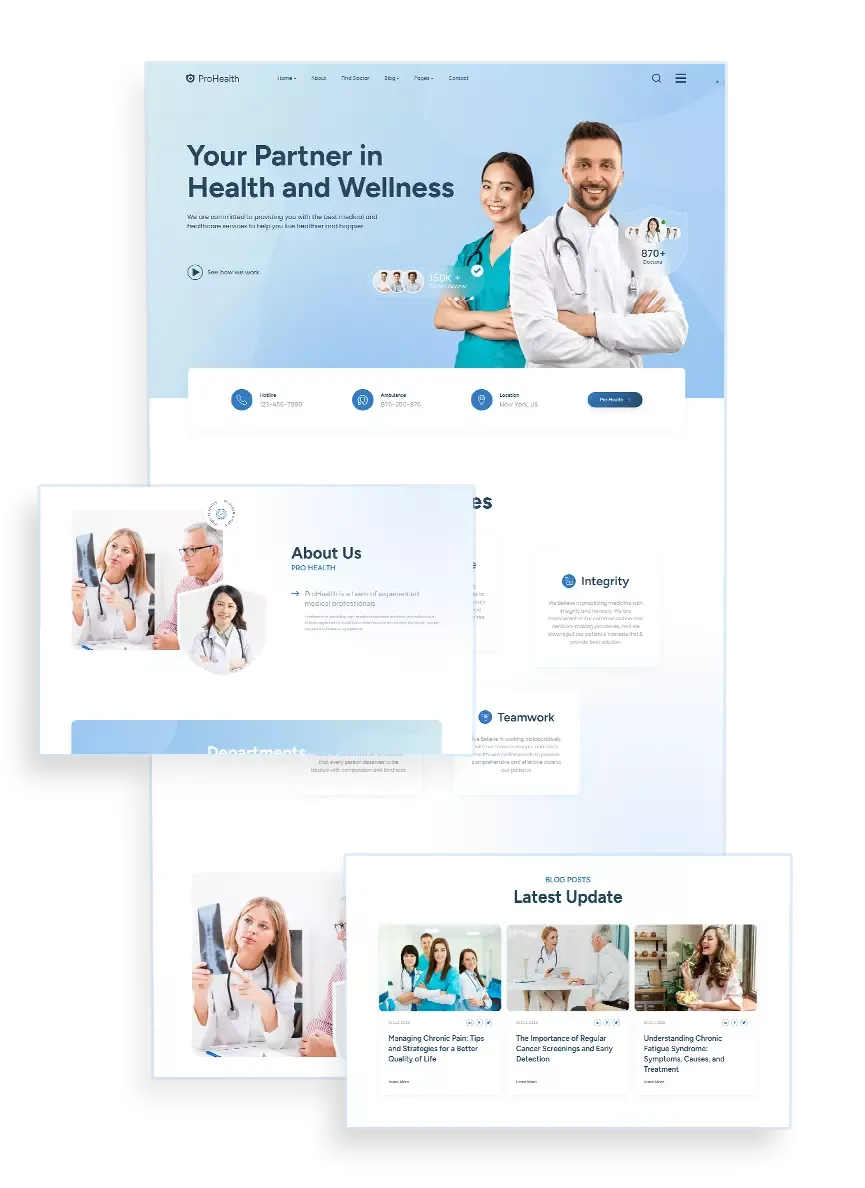
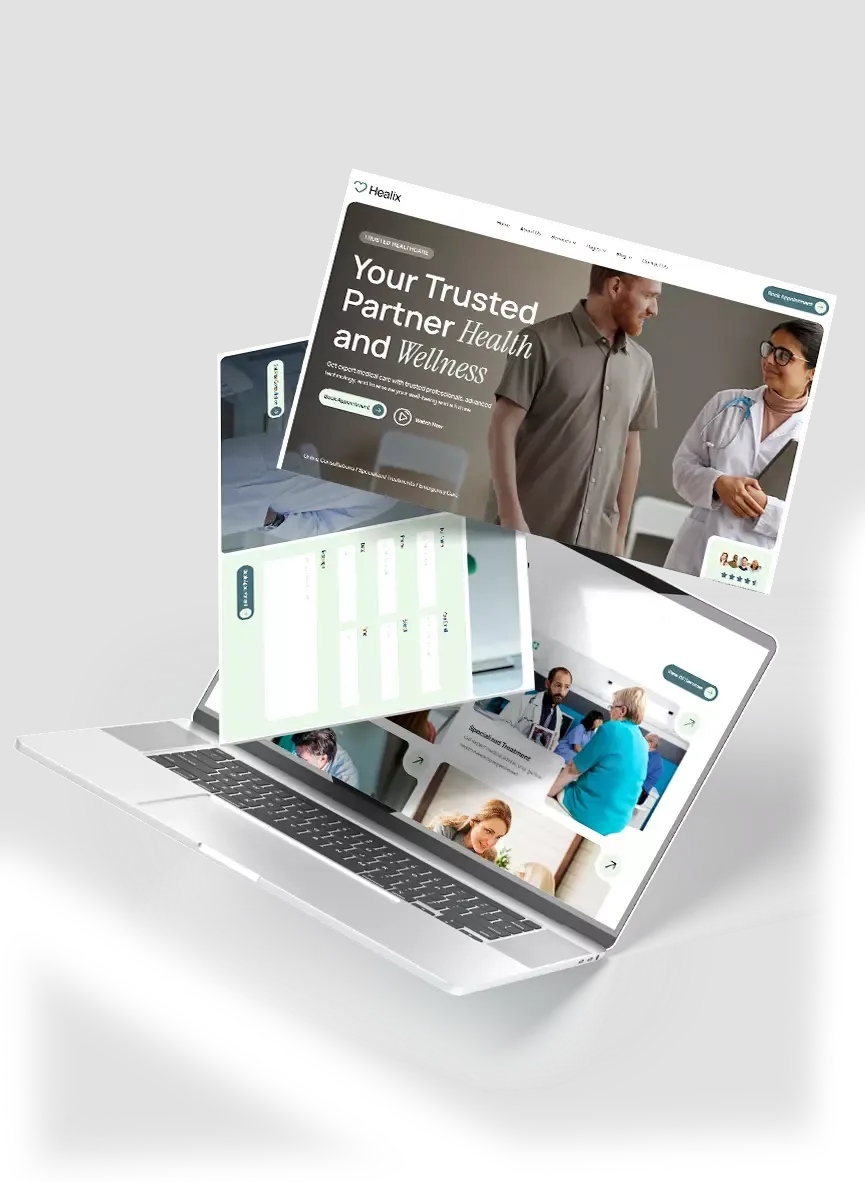
Healthcare Website Design for Clearer Patient Information
Visitors should be able to find the service they need, understand who provides it and reach the appropriate appointment or contact route. A healthcare website needs a clear information structure and careful decisions about the systems it connects to.
Allusive Digital designs and develops healthcare websites around provider-approved content and defined functional requirements. The project scope should separate a public information website from systems that handle sensitive patient information.
Who We Build Healthcare Websites For
General Practice / Family Medicine
Online booking with calendar integration, insurance/bulk-billing information, provider bios, location and hours, patient forms, telehealth appointment option, GBP integration.
Healthcare web design sits at the intersection of four demands that don't apply to other industries simultaneously:
Privacy Law Compliance
HIPAA (US), PIPEDA (Canada), Privacy Act 1988 (AU), and Privacy Act 2020 (NZ). Any contact form, patient portal, or data collection must be compliant with applicable law. We build with privacy-first architecture from the first line of code.
Accessibility
ADA and WCAG 2.1 AA compliance. Healthcare patients include elderly, vision-impaired, and mobility-impaired individuals. ADA lawsuits targeting healthcare websites have increased significantly. We build accessibility in, not as an afterthought.
Google applies its highest scrutiny to YMYL (Your Money Your Life) pages, including healthcare. Provider credentials, institutional signals, and authored content are essential for ranking.
Patient Trust at First Visit
Potential patients making high-stakes decisions about their health need to see credentials, team quality, and care experience within the first 10 seconds. Generic templates fail every one of these requirements.
Help visitors find the right information
Service pages
Explain each service using content approved by the provider. Make the intended audience and next step clear without substituting marketing language for information a visitor needs.
Provider and practice information
Present accurate team details, contact routes and practical information. Assign someone to approve credentials, service descriptions and changes before publication.
Navigation and readability
Use clear labels, readable text and a layout that remains usable on mobile. Accessibility should be considered during design and tested as part of the project, not represented by an unsupported compliance badge.
Plan the appointment journey around approved systems
An appointment link, booking integration and patient portal are different requirements. Identify which system will handle the task, who manages it and which information it receives. Do not collect sensitive health details through a general website form simply because that form is easy to add.
Appointment link
Handles the task
Managed by
Receives
Booking integration
Handles the task
Managed by
Receives
Patient portal
Handles the task
Managed by
Receives
Any privacy, security or regulatory requirements must be reviewed by the provider and appropriate specialists. A website template or a particular CMS does not establish compliance by itself.
Keep content ownership clear after launch
Services, provider details and contact information change. Decide who will maintain each part and how specialist content will be reviewed. The CMS should support that workflow without making routine edits unnecessarily difficult.
Platform Integration: HotDoc and HealthEngine integrations.
Service Areas: Serving Sydney, Melbourne, Brisbane, Perth, and Adelaide.
New Zealand
Compliance & Standards: Privacy Act 2020, Medical Council of New Zealand (MCNZ) standards, and ACC & community services display.
Platform Integration: ManageMyHealth integration.
Service Areas: Serving Auckland, Wellington, Christchurch, and Hamilton-Tauranga.
Healthcare website questions
Healthcare websites start from $1,000 for solo practitioners and $15,000 to $35,000 for group practices. Specialist clinics typically run $10,000 to $28,000. Multi-location medical groups invest $35,000 to $100,000 or more. All projects are fixed-price with itemised quotes.
We build with HIPAA-conscious architecture including secure contact forms, appropriate data transmission standards, and guidance on compliant hosting. For formal HIPAA audits, particularly for practices with patient portals or EHR integration, we recommend working alongside a healthcare compliance specialist.
Yes. We integrate with HotDoc, HealthEngine, Calendly for healthcare, Jane App, Cliniko, and NZ-specific platforms, as well as building custom appointment request forms. Patients should be able to request or book an appointment within 60 seconds from any page on the site.
WCAG (Web Content Accessibility Guidelines) 2.1 AA is the international standard for digital accessibility. Healthcare websites in the USA must comply with ADA. In Canada, provincial accessibility laws apply. In Australia, the Disability Discrimination Act applies. Beyond legal compliance, healthcare patients include elderly and vision-impaired individuals, accessibility is an ethical obligation.
Healthcare pages are classified as YMYL by Google and held to higher trust standards. Ranking requires E-E-A-T implementation (provider credentials visible, authorship clear, institution signals present), technical SEO, and local SEO targeting '[specialty] [city]' queries. We build all of this in from the start.
Solo practitioner sites take 4 to 7 weeks. Group practices take 7 to 12 weeks. Multi-location medical groups take 12 to 24 weeks depending on number of locations, practitioners, and specialty pages.
That depends on the approved system and available integration. Share the provider and intended workflow so the requirement can be assessed before quoting.
Provider-approved information should be the source for specialist claims. Content responsibilities and review must be agreed before publication.
No general website package can establish that. Relevant requirements need their own review and appropriate technical implementation.
Start with the information and workflow
Share the current website, required pages and the systems already used by the organization.
Digitizing Your Business Growth
At Allusive Digital, we empower brands to thrive in the digital world. From logo creation and web development to SEO, social media, and content strategy, our end-to-end services are designed to accelerate your growth. We combine creativity, technology, and data-driven strategies to help you stand out, attract customers, and scale efficiently in an ever-evolving online marketplace.