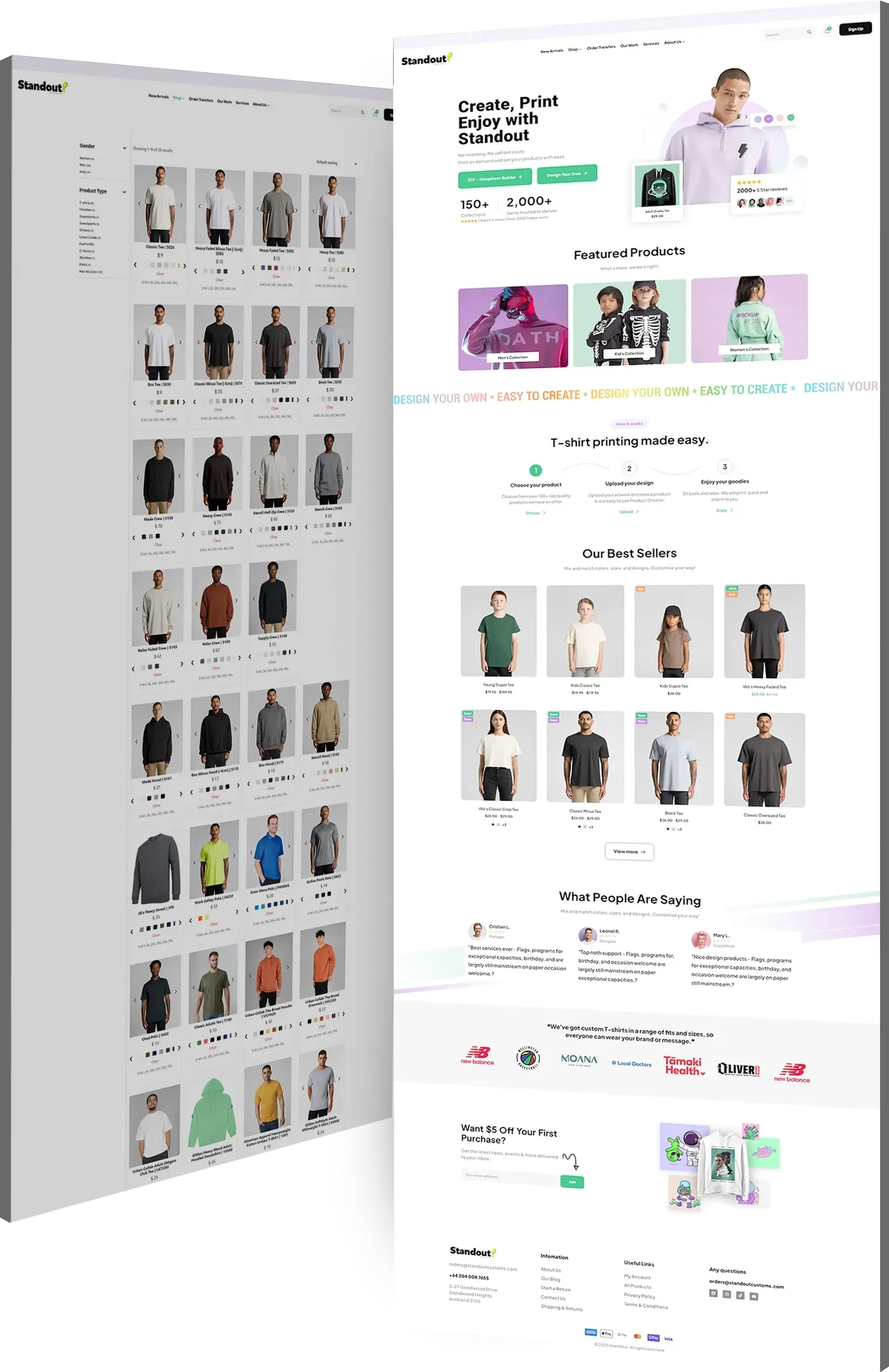
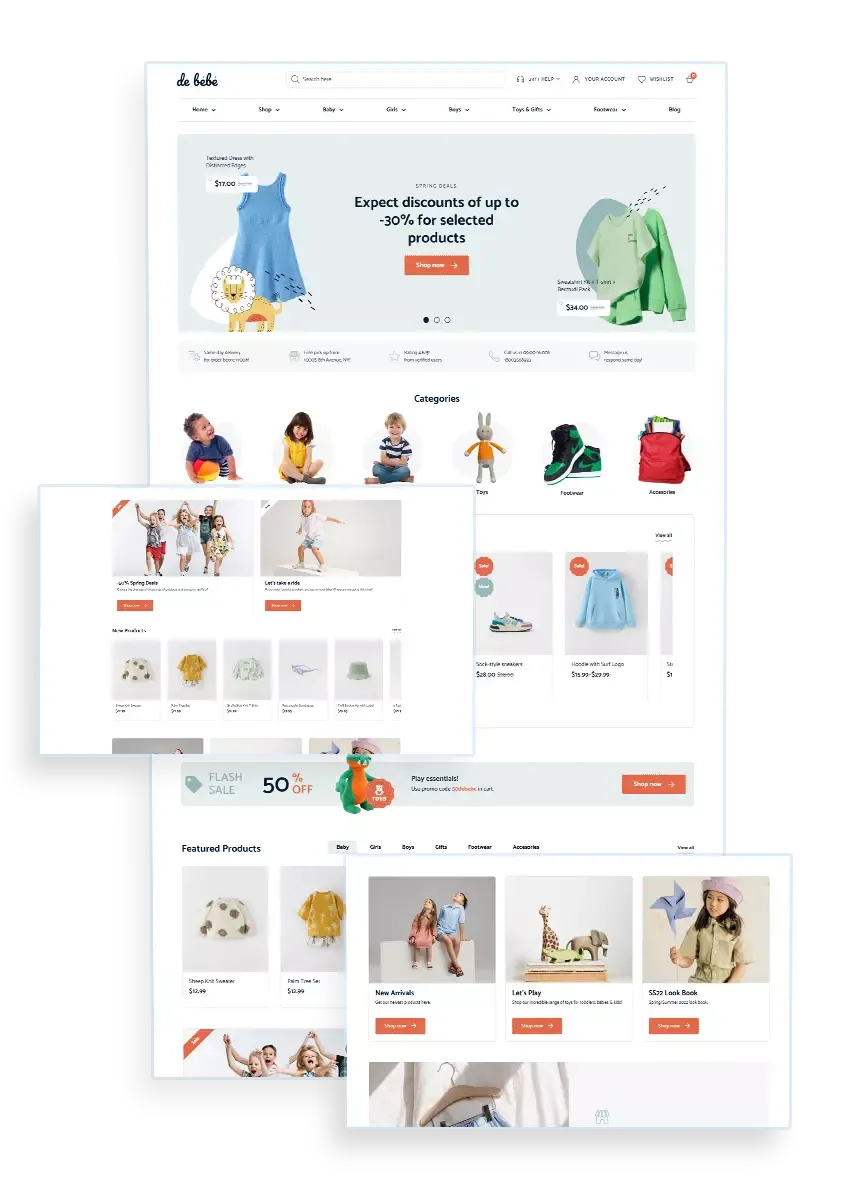
A store should help customers find the right product, understand the important details and complete an order. It also needs to fit the way your team manages products, payments and fulfilment.
Allusive Digital provides ecommerce website design and development for new stores, redesigns and platform migrations. We begin with your catalogue and operating requirements so the project covers more than the homepage design.
What We Build for E-Commerce Brands
Custom Product Page Architecture
Hero image, social proof, variant selectors, stock indicators, urgency signals, and a single clear CTA. Each product page is structured with Product schema for Google Shopping integration and rich result eligibility.
Category / Collection Page SEO
Category pages with proper heading structure, descriptive copy, internal linking, and breadcrumb schema. The highest-value SEO work on an e-commerce site — they rank for broad, high-volume queries product pages cannot target.
Accelerated Checkout
Shop Pay, Apple Pay, Google Pay, Afterpay, Klarna, and Zip configured from day one. For WooCommerce, single-page checkout with autofill and payment method breadth matching your market.
Mobile-First Performance
90+ Lighthouse performance scores on mobile as standard. Image lazy loading, critical CSS, minimal JavaScript execution, and CDN delivery are baseline configuration.
Headless Commerce Option
For brands needing sub-second load times or custom frontend experiences beyond native Shopify, we build headless commerce on Next.js with Shopify Storefront API — the fastest-growing architecture for enterprise DTC brands.
Conversion Rate Optimisation
Cart abandonment recovery, exit-intent, and post-purchase upsell flows built in. CRO is not a separate service, it is designed into every element from product listing to confirmation.
Product Schema & Google Shopping
Product schema with pricing, availability, reviews, and GTIN feeds Google Shopping and enables rich result display (price, rating, availability) directly in organic search before a click.
Why Generic E-Commerce Websites Lose Revenue
The five most common e-commerce website failures we see in 2026:
Slow Page Speed
For every 100ms improvement in load time, conversion rates improve by 1%. An e-commerce site taking 4 seconds to load is leaving measurable revenue on the table on every page load.
Poor Mobile Checkout
Mobile commerce accounts for 72% of e-commerce transactions in 2026. A checkout flow requiring 8 fields on a small screen has a statistically higher abandonment rate than one using autofill, Apple Pay, and one-tap checkout.
Unoptimised Product and Category Pages
Most e-commerce sites are never found in Google because their product pages have thin content, duplicate meta descriptions, and no structured data. We build product and category pages with the content architecture Google needs.
No Post-Purchase Experience
The most valuable customer is a repeat customer. A website with no loyalty integration, post-purchase email trigger, or review request automation loses lifetime value on every order.
Wrong Platform for the Business Model
Shopify is not always the right answer. A subscription-first business or B2B catalog may need WooCommerce, Magento, or headless architecture.
Plan the buying journey from collection to checkout
1
Product discovery
Organize categories and collections around the way customers browse. Filters and search need to reflect useful product attributes rather than create unnecessary complexity.
2
Product information
Give customers clear descriptions, images, variants and practical purchase information. Identify which details your team supplies and how they will be maintained as the catalogue changes.
3
Checkout and trust information
Review the path from a product to an order alongside payment, delivery and returns information. The implementation depends on the chosen platform and services; important requirements should be checked before they become promises in a quote.
Choose an ecommerce platform around the business
Shopify development and a WordPress-based WooCommerce build have different operating models. Compare catalogue needs, integrations, editing, maintenance and recurring charges. A familiar platform name does not make every store requirement straightforward.
Business buyers may need account access, different pricing arrangements, approval steps or repeat-order features. Write down the intended workflow before selecting the platform and integrations. A B2B requirement can change the project even when the visible catalogue looks similar to a retail store.
Account access
Different pricing arrangements
Approval steps
Repeat-order features
Ecommerce redesign and migration
A store migration can involve products, media, customer data, order information and URLs, subject to platform capability and permissions. Agree which data needs to move and identify integrations that must be reconnected or replaced.
Preserve a record of URL changes and test important store journeys before launch. A redesign should also look at product content and navigation; moving the same unclear information into a new theme may leave the buying problem unchanged.
ProductsMediaCustomer dataOrder informationURLs
Subject to platform capability and permissions.
Ecommerce projects for Los Angeles businesses
If your project is focused on the Los Angeles market, start with our Los Angeles website design services and use this page for the store requirements. One ecommerce service page can explain platform and buying-journey work without creating duplicate location-specific store pages.
Scope and costs
The quote should separate design and development from platform fees, paid extensions, subscriptions and ongoing support. Catalogue preparation and content entry also need an agreed owner.
All projects are fixed-price and scoped upfront. For a full cost breakdown, see our web design pricing guide.
E-Commerce Markets
United States
Payment Gateways: Shopify Payments, Stripe, Afterpay, Klarna, and Zip.
Logistics & Shipping: USPS, UPS, FedEx, and ShipBob integration.
Integrations: Google Shopping US feed.
Canada
Payment Gateways: Shopify Payments Canada, Interac, and PayBright.
Logistics & Shipping: Canada Post and Purolator integration.
Regional Features: GST/HST display by province, plus bilingual store capability for Quebec.
Service Areas: Serving Langley, Vancouver, Surrey, Toronto, Calgary, and Ottawa.
Australia
Payment Gateways: Shopify Payments AU, Afterpay, Zip, and PayID.
Logistics & Shipping: Australia Post and Sendle integration.
Regional Features: GST-inclusive pricing display.
Service Areas: Serving Sydney, Melbourne, Brisbane, Perth, and Adelaide.
New Zealand
Payment Gateways: Shopify Payments NZ, Laybuy, Afterpay NZ, and Genoapay.
Logistics & Shipping: NZ Post integration.
Regional Features: GST pricing display.
Service Areas: Serving Auckland, Wellington, Christchurch, and Hamilton-Tauranga.
Ecommerce project questions
E-commerce websites start from $1,000 for a Shopify or WooCommerce starter store with up to 500 products. Growth-stage brands typically invest $25,000 to $60,000. Enterprise Magento or Shopify Plus builds run $60,000 to $150,000. Headless builds start from $80,000.
Shopify is better for DTC brands wanting an all-in-one managed platform with minimal developer overhead. WooCommerce is better for content-heavy stores, complex pricing logic, and teams already on WordPress. See our detailed 2026 Shopify vs WooCommerce comparison for a full breakdown.
Yes. We audit your existing store's performance, ranking pages, and conversion funnel before redesigning — ensuring we preserve what is working in Google while improving everything that is not converting.
E-commerce SEO focuses on technical (Core Web Vitals, crawlability, structured data), on-page (category content, product descriptions, internal linking, canonical handling), and off-page (review schema, Google Shopping feed, link building). We build technical and on-page foundations into every store.
Yes. Afterpay, Klarna, Zip, Laybuy, Latitude Pay, and PayBright are configured on applicable platforms in each of our four markets. BNPL display on product pages is now conversion-standard in fashion, homewares, and electronics.
Starter stores take 8 to 12 weeks. Growth-stage stores take 12 to 18 weeks. Enterprise takes 18 to 30 weeks. Headless builds take 24 to 40 weeks. All timelines confirmed in writing before starting.
Yes. Share the store and the issues you want to address. A focused improvement may be more appropriate than a complete rebuild.
That needs to be checked against the source and destination platforms, data quality and permissions. Agree the transfer scope before the migration begins.
No. The store experience is one part of the business. Products, pricing, traffic, demand and fulfilment also affect sales.
At Allusive Digital, we empower brands to thrive in the digital world. From logo creation and web development to SEO, social media, and content strategy, our end-to-end services are designed to accelerate your growth. We combine creativity, technology, and data-driven strategies to help you stand out, attract customers, and scale efficiently in an ever-evolving online marketplace.